\\\- [ HUMAN_RIGHTS ]-AI EMPLOYMENT DESTRUCTION -///
American Jobs Replaced By A Totalitarian Super Bot Technology State.
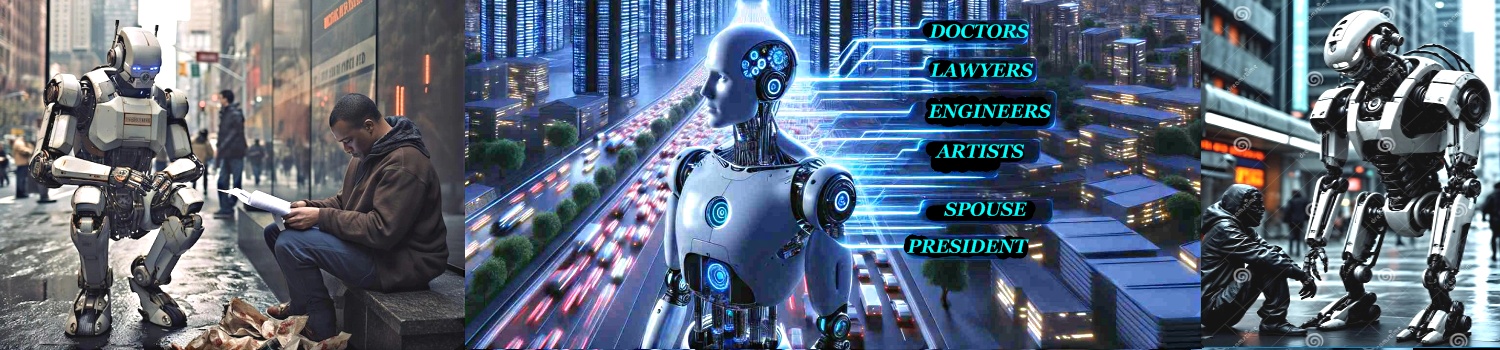
Machines Replacing People In Society.
Foreword by OracleDream.com
Lance Roman, OracleDream.com
Remember When the free trade agreements were signed into law, NAFTA / GAT. – The critics warned they were going to destroy US manufacturing. They were called alarmists,– there was nothing to worry about because, — ” All the people losing there jobs, will find new ones using the cheap products from china to start their own business. ”
—-
Didn’t work out that way did it ! — 20 years After, 10’s of thousands of abandoned factories. Between the factories and the support industries connected to them, millions lost there jobs. 1/3 of the people went into the service sector, 1/3 retired, and a third became bums riding trains. Entire cities and neighborhoods became ghost towns. Who benefited ? — Corporations, Wall Street, and Rich people with portfolios.
—-
Now Here we go again with Artificial Intelligence, the critics are giving the same warning about the job loss. They are being called alarmists because all the people losing their job will use ” AI to create their own business.” — Different problem,- same bullshit excuse. But who is really going to benefit ? I tell you who, – Corporations, Wall Street, rich people with portfolios and abusive governments.
—-
I got news for everyone out there that thinks AI is going to cure cancer and create flying saucers. That’s nonsense. AI uses gigantic data centers to access all human knowledge. It uses the information to answer a question or task by re-writing the stored Information into a conclusion or option base method of action. But, — if you ask AI to build a flying saucer it will not be able to because the information isn’t searchable. AI doesn’t actually “think” and it certainly can not think abstractly.
—-
But unfortunately, —- it is capable of replacing the functionality of human beings.
—-
Has anyone noticed that every time a new technology emerges it’s touted as a great thing for society. But the same technology with the positive attached to it, – is always used by people to hurt, abuse, and kill other people.
—
The Airplane and Automobile, — from the instant they appeared to transport and benefit people, they were turned into terrible weapons of war.
—
How about the cell phone? It’s convenient to carry a small computer, video camera, internet, device in your pocket. But it’s also used by governments and corporations to spy, track, and steal personal info and sell it. It disconnects reality and subjugates people into a tech slave that can be arrested at the governments convenience . Google named its phone operating system “android” . The Websters dictionary Definition of which is , — [ A mechanical man, – an automaton that resembles a human being ] . This was no accident on the part of google
—
The cell phone is step one of the tech industries master plan, A plan created by a transhumanist religion that seeks to transform people into machines. Now, with artificial Intelligence infiltrating societies, the complete takeover is underway.
—
But there is another motivation to do this, Greed. To acquire more money than anyone could need at the expense of others.
—-
The tech industry is comparable to the televangelist, using religion and tech to create obscene wealth.
—
Lets ask ourselves a question, — who knows more about God ? The preacher standing on the street corner soap box, — or the T.v. ministry on 20 T.v stations. The answer is clear, the televangelist knows more about capitalism, but he doesn’t know more about God.
—
Lets ask ourselves another question, — Who knows better on how to handle AI ? The creator of this website,– or the transhumanist tech industry. The answer is clear, — The tech industry knows how to prostitute the buying and selling of people, — but it doesn’t know what’s best for people.-
—
On this website moralistic intellect is not for sale.
—
The Trump Admins position on AI can be seen as simplified mechanics. The solution to the AI problem is to do it bigger and better than anyone else, that method will work when building an — Airplane, Train, Rocket ship or Economic policy. But disaster is eminent when applied to the broad scope of AI abuses on human rights.
—
This Is Because — The Bigger And Better Artificial Intelligence Is Made, — The More Dangerous It Is.
[oracledream.com-Lance Roman.]
—–
—–
https://www.foxnews.com/opinion/new-ai-poll-reveals-elites-way-out-step-rest-of-us
How AI tools turn into job-killing machines. The artificial intelligence future of American workers.
By Kurt Knutsson, CyberGuy Report Fox News.
—-
Imagine walking into work, feeling the hum of the office around you and settling into your desk, all the while unaware of the unseen eyes monitoring your every move.
—-
It’s happening on a grand scale as corporations use advanced software to keep tabs on their employees. There’s a twist in the narrative here. Experts fear that this extensive data collection could be a stepping stone, a way to train AI to replace human roles in the workforce.
Learning the ropes from humans
It’s a familiar story – the experienced worker trains the newbie, only to be replaced once the newcomer is up to speed. This age-old tale is on the verge of adding a new character to its plot: artificial intelligence.
—-
Over the years, numerous reports have suggested the looming threat of automation over various job sectors, both blue-collar and white-collar. The advanced capabilities of AI tools to handle data-intensive and repetitive tasks are reshaping the job scenario, spanning diverse fields from banking to law and beyond.
How corporate spyware trains AI to eventually replace human workers
Enter corporate spyware, an unnoticeable training ground for AI. As employers monitor their workforce, the extensive data being gathered turns into a goldmine for training AI.
—-
Companies are not just observing employees but also making them frequently interact with AI tools. This interaction provides invaluable data and insights, contributing to the creation and refinement of AI models that could eventually replicate and replace human roles.
How AI is showing up in the workplace
Customer service bots: In customer service departments, employees often interact with AI-powered chatbots and virtual assistants. These tools are used to handle and resolve customer inquiries and issues efficiently.
—-
The AI learns from the interactions, understanding the nuances of customer communication and the methods employees use to resolve various issues. This data can be utilized to improve the AI’s performance and potentially enable it to handle more complex tasks independently, without human intervention.
—-
Data analysis tools: Many corporations employ AI-powered data analysis tools. Employees interact with these tools to analyze large datasets, glean insights and make data-driven decisions. By observing and learning from the employee’s interactions, the AI can enhance its analytical capabilities, learn to recognize patterns and insights independently and eventually perform comprehensive data analysis without human oversight.
—-
Automated scheduling and administrative tasks: Employees often use AI tools for scheduling, email sorting and other administrative tasks. These tools learn from employee preferences and behavior to optimize scheduling, organize emails and perform other administrative tasks more efficiently. The more employees interact with these tools, the more data the AI collects about optimal strategies and solutions for these tasks, improving its ability to perform them autonomously.
—-
This strategy may lead to the development of AI programs that can observe, learn and eventually perform the job as efficiently as, if not more so than, human employees. All without needing salaries, benefits or breaks.
How do you handle the impact of AI on your job?
People are noticing that AI is silently learning from our everyday tasks and interactions at work. It’s subtle and quiet, but it’s making a mark. The chatter out there is mixed – not everyone is convinced it will entirely reshape the job market, but there’s a feeling that change is on the horizon.
—-
Some jobs might morph into something new, integrating more AI tools to make tasks easier and more efficient. On the flip side, other jobs, especially those that are repetitive and data-heavy, might just fade away and be replaced by advanced AI systems.
How AI can learn from us and possibly even surpass us
As AI continues to grow and learn from us, it’s getting better at doing what we do, and then outperforming us. The data collected from monitoring workplace activities and interactions with AI tools is like gold, used to refine and enhance AI capabilities further. This ongoing cycle of learning and improvement is pushing AI systems to new heights, making them more competent and capable of handling complex tasks autonomously.
People Pushed Out Of Relevant Society.
What about the workforce? There’s a concern that as AI takes on more responsibilities, folks might find themselves nudged out, forced to look for other roles or adapt to the changing tide by being forced to learn new skills embracing the AI transformation. It’s a bit of a mixed bag, and the uncertainty is real. There’s a feeling of dread as we stand on the brink of this AI evolutionary takeover of our lives.
[edited-oracledream.com-Lance Roman.]
—–
—–
https://www.windowscentral.com/artificial-intelligence/microsoft-reveals-40-jobs-about-to-be-destroyed-by-and-safe-from-ai
AI threatens to eliminate 40 job roles, according to Microsoft’s latest research finding
By Jez Corden
A Microsoft Research paper has listed out 40 professions it believes are most at risk from the rise of AI,
—-
It’s RIP for journalists and many other professions, according to Microsoft Research.
—-
In a new paper recently published by Microsoft’s research division, a team of data scientists revealed a variety of professions most likely to be impacted by AI based on a variety of factors. The team studied the United States job market specifically, although it stands to reason that, without some form of global regulation, these predictions could apply to virtually any developed or developing nation right now.
—-
Microsoft Senior Researcher Kiran Tomlinson described the study as such, “Our study explores which job categories can productively use AI chatbots. It introduces an AI applicability score that measures the overlap between AI capabilities and job tasks, highlighting where AI might change how work is done, not take away or replace jobs.” Tomlinson continued, “Our research shows that AI supports many tasks, particularly those involving research, writing, and communication, but does not indicate it can fully perform any single occupation. As AI adoption accelerates, it’s important that we continue to study and better understand its societal and economic impact.”
—-
Indeed, the study determines how “applicable” AI is to certain job roles, which in theory could be used to enhance productivity therein, but in practice, will most likely be used to justify reducing team sizes — outsourcing human work to AI models. Microsoft itself is thought to have laid off over 15,000 people this year due to the “application” of AI, and prioritizing its growth over other parts of the business. If AI can make a single individual in a company “more productive,” potentially doing the work of two people, it conceivably justifies eliminating roles. So far, there’s no evidence that AI has led to job creation in most, if any, of the careers listed below. Much to the contrary, former Microsoft CEO Bill Gates himself has rang alarm bells about how AI will destroy jobs.
—-
Microsoft is at the absolute forefront of artificial intelligence, with its Azure data centers contributing processing power to models like ChatGPT, DALL-E, and Grok. Its Copilot chatbot is baked into Windows, and its business-grade solutions in Microsoft 365 aim to help users save time by offloading more menial tasks.
—-
Increasingly, though, it seems that both current and future AI models will be able to not only offload those menial tasks but also replace entire professions. AI at scale could lead to a variety of unknown consequences that governments and society at large seem ill-prepared for — but perhaps there are opportunities around the corner, too?
—-
In any case, here’s the list of 40 jobs most impacted by AI, and the 40 least impacted, according to Microsoft Research.
Top 40 jobs using AI applications the most
–
Job Title – Employment
1 Interpreters and Translators — 51,560
–
2 Historians — 3,040
–
3 Passenger Attendants — 20,190
–
4 Sales Representatives of Services — 1,142,020
–
5 – Writers and Authors — 49,450
–
6 Customer Service Representatives — 2,858,710
–
7 CNC Tool Programmers — 28,030
–
8 Telephone Operators — 4,600
–
9 Ticket Agents and Travel Clerks — 119,270
–
10 Broadcast Announcers and Radio DJs — 25,070
–
11 Brokerage Clerks — 48,060
–
12 Farm and Home Management Educators — 8,110
–
13 Telemarketers — 81,580
–
14 Concierges — 41,020
–
15 Political Scientists — 5,580
–
16 News Analysts, Reporters, Journalists — 45,020
–
17 Mathematicians — 2,220
–
18 Technical Writers — 47,970
–
19 Proofreaders and Copy Markers — 5,490
–
20 Hosts and Hostesses – 425,020
–
21 Editors — 95,700
–
22 Business Teachers, Postsecondary — 82,980
–
23 Public Relations Specialists — 275,550
–
24 Demonstrators and Product Promoters – 50,790
–
25 Advertising Sales Agents — 108,100
–
26 New Accounts Clerks — 41,180
–
27 Statistical Assistants — 7,200
–
28 Counter and Rental Clerks — 390,300
–
29 Data Scientists — 192,710
–
30 Personal Financial Advisors – 272,190
–
31 Archivists — 7,150
–
32 Economics Teachers, Postsecondary — 12,210
–
33 Web Developers — 85,350
–
34 Management Analysts — 838,140
–
35 Geographers — 1,460
–
36 Models — 3,090
–
37 Market Research Analysts — 846,370
–
38 Public Safety Telecommunicators — 97,820
–
39 Switchboard Operators — 43,830
–
40 Library Science Teachers, Postsecondary — 4,220
A lot of the jobs in the top 40 revolve entirely around what LLMs like ChatGPT seem to be able to do best. It’s all largely impersonal, easily digitizable work that can be reproduced easily by AI. I ranked the table by how the research describes AI applicability, which refers to how often AI was being utilized by individuals in these professions.
—-
I was surprised to see professions like modelling on the list, but it makes sense when you can easily ask ChatGPT or Copilot to generate an image of a “model” doing anything you want with a simple command prompt. —-
—-
Perhaps I should consider a career in phlebotomy, or become a masseuse?
—-
The jobs least at risk are ones that seem to require a physical human touch, literally in some cases. Jobs like massage therapists, builders, roofers, engineers, and surgeons seem safe from AI today. But it’s certainly true that robots are becoming increasingly sophisticated and tactile as well — you’d have to think that it’s only a matter of time before humanoid robots, designed by AI itself, could supplant a lot of these roles as well.
—-
Artificial Intelligence is going to have massive implications for the world, much like the industrial revolution did back in the 1800s. I often see investors and technologists hand-wave and apply analogies like “cars destroyed the horse and cart industry,” but increasingly, we’re seeing governments waking up to the absolute carnage this technology could wreak.
—-
With our entire economic system revolving around work, and increasingly white collar work, vast unemployment, the likes of which has never been seen before, could trigger all sorts of social turmoil. Governments certainly seem ill-prepared for the AI worst-case scenario situations, even before you consider artificial general intelligence and self-replicating improvement models that are on the horizon.
—-
AI could turbocharge inequality and wealth disparity, with societies voting for populist candidates who promise a world of change while delivering more of the same. There’s only so much bullshit society can take, and AI could be the spark to tip it over the edge.
—-
But what about the benefits? AI could speed up disease and cancer solutions, able to experiment, comprehend, and parse data far faster than huge teams of scientists could manually. Perhaps AI itself comes up with economic solutions to solve the looming unemployment crisis, with some form of distributed universal basic income, touted by some, as freeing humanity from the toils of work in general.
—-
I tend to gravitate towards more cynical expectations about the future — but much like the industrial revolution, it created plenty of turmoil, but it’s undeniable how it advanced society as a whole. It created entirely new industries and opportunities and vastly boosted life expectancies globally, owing to things like industrialized agriculture, advances in medicine, and so on.
—-
Will AI eliminate the need to work completely? Will we end up as a fusion-powered space-faring species? Or, could we find ourselves in The Matrix or Terminator? Or could all of us end up the poverty class of a welfare machine state communism. We won’t have to wait too long to find out.
[edited-oracledream.com-Lance Roman.]
—–
—–
https://www.weforum.org/stories/2025/08/the-overlooked-global-risk-of-the-ai-precariat/
Jobs and the Future of Work The overlooked global risk of the AI precariats
With AI disrupting employment, millions could face the loss of purpose, identity and social belonging.The psychological toll of sudden AI-driven unemployment remains largely unaddressed.
—–
If we want AI to be remembered as a tool for human flourishing, rather than mass alienation, we must start planning, not just for the jobs AI will create – but for the dreams it might erase.
—–
When we are young, we dream about what we want to be when we grow up. But in the age of AI, many of those dreams are being rewritten – or erased. Even for those already building careers or firmly established in their field, AI is quietly changing the rules. The global conversation has focused mostly on productivity gains, competitive advantage and regulation; some celebrate AI’s potential to create new jobs. But what about those who fall through the cracks? The psychological toll of sudden AI-driven unemployment remains largely unaddressed. Who will we be without our work?
A looming global identity crisis
It’s time to focus on the global occupational identity crisis that is looming – the loss of purpose, structure and social belonging that comes when work disappears. It will accelerate the rise of what economist Guy Standing in 2011 coined the precariat – a class defined by insecurity, exclusion and anxiety. Today’s version of this, what I term the AI precariat, will not just be unemployed or underemployed. As income disappears, identity and meaning may vanish too, with real consequences for mental health.
—–
In my work over the last two years, I have highlighted this AI-driven occupational identity crisis as a blind spot in global risk planning. Most recently, at the retreat of the World Economic Forum’s Global Foresight Network, of which I am a member, this issue sparked urgent discussion. Bottom line: the identity crisis is real and underestimated.
—–
The predictions about unemployment rates and timing vary. Some tech leaders, like Nvidia’s Jensen Huang, argue that AI will create more and ‘superior’ jobs. Others are less optimistic. Anthropic CEO Dario Amodei has warned that AI could eliminate half of all entry-level white-collar jobs within one to four years. The IMF warns that 60% of jobs are already exposed to AI in advanced economies and 40% in emerging markets. The Inter-American Development Bank’s index of occupational exposure finds that 980 million jobs worldwide face high disruption risk in the next year. And, the World Economic Forum’s 2025 Jobs of the Future Report reveals that due to AI, 41% of employers intend to reduce their workforce by 2030.
Disrupting the anchor of work
These numbers capture the economic disruption. But we rarely connect the dots to what happens next – when millions lose not just income, but the anchor that work provides. What happens when our education or years of work experience don’t matter as much anymore? Many may face a grim choice: scramble to ‘learn AI’ to stay relevant – or drift into a new class, uncertain where they can fit in the AI economy. As some professions become obsolete, many will feel left behind. This could lead to recurrent anger against governments.
This disruption won’t arrive all at once – it will come in waves
Wave 1: Traditional automation continues to displace routine, manual and service jobs.
—-
Wave 2: Generative AI is already reshaping content creation, routine cognitive tasks and repetitive knowledge work in sectors like marketing, law, finance and tech.
—-
Wave 3: Agentic AI is already executing multi-step tasks without human input, impacting jobs in human resources, market research and IT support. It may eventually replace mid-level and managerial roles, restructuring entire organizations.
—-
Wave 4: Artificial general intelligence (AGI) could perform most cognitive tasks by 2030, rendering entire professions obsolete. Artificial super intelligence (ASI) may follow, surpassing human capabilities.
From capitalism to AI created Communism
Each wave will displace another segment of the global working population. The challenge isn’t just how to re-employ people, but how to help them adapt to a future where their previous skills or identities may no longer be relevant. In a way, we’ve seen this before. From post-coal Britain to post-industrial American towns, when livelihoods vanished, for many mental health deteriorated, addiction rose and political extremism found fertile ground. The AI wave could replicate those dynamics – but on a global scale and at a much faster pace. It could even lead to a tech-lash.
—–
Are we prepared? Many governments and companies have invested heavily in AI strategies focused on innovation, education and upskilling – and that matters. But few are preparing for the psychological demands ahead. Who will address the unique challenges of the AI precariat: the grief of losing a profession, the potential alienation from society and the possible breakdown of civic trust?
From risk to response
A new human-centred social contract in the age of AI must value dignity and identity as much as employment. That means:
• Universal access to mental health care
—-
• Reimagined social safety nets
—-
• Concrete efforts with basic income, civic stipends or job guarantees
—-
• Lifelong learning paired with lifelong belonging
—–
This also means acknowledging occupational identity loss as a real global risk – not a side effect. It must be integrated into workforce transition plans, not left to families and individuals to manage alone.
A few concepts to try and deal with the employment crisis.
Precariat labs: Cross-sector hubs where governments, companies and civil society test interventions for those at risk of AI-driven job loss. These would integrate mental health care, retraining and community-building to preserve livelihoods and identity.
—-
Universal basic income focused on purpose: An evolution of universal basic income designed to restore purpose, belonging and meaning outside formal employment – through civic projects, creative pursuits or skill-sharing networks. This will be the official position of the government to justify a technocratic driven – Communism –
—-
Perhaps, we also need a new global metric: an AI Anxiety Index to track how occupational displacement affects mental well-being across societies – and to help shape timely interventions.
—–
The AI precariat may not make headlines like billion-dollar chip deals or breakthrough models. But it will shape the political, social, economic and security terrain of the next decade. If we want AI to be remembered as a tool for human flourishing, rather than mass alienation, we must start planning for the dreams it will erase.
[edited-oracledream.com-Lance Roman.]
Machines Replacing People In Society.
—–
https://www.cbsnews.com/news/prince-harry-steve-bannon-unlikely-allies-ai-superintelligence-ban/
Many big names in group of unlikely allies seeking ban, for now, on AI “superintelligence”
——- Prince Harry and his wife Meghan have joined prominent computer scientists, economists, artists, evangelical Christian leaders and American conservative commentators Steve Bannon, Glenn Beck, and Lance Roman creator of M.a.g.a. Site OracleDream.com, to call for a ban on AI “superintelligence” they say could threaten humanity.
—-
The letter, released Wednesday by a politically and geographically diverse group of public figures, is squarely aimed at tech giants like Google, OpenAI and Meta Platforms that are racing each other to build a form of artificial intelligence designed to surpass humans at many tasks.
—-
The 30-word statement says, “We call for a prohibition on the development of superintelligence, not lifted before there is broad scientific consensus that it will be done safely and controllably, and strong public buy-in.”
—-
In a preamble, the letter notes that AI tools may bring health and prosperity, but alongside those tools, “many leading AI companies have the stated goal of building superintelligence in the coming decade that can significantly outperform all humans on essentially all cognitive tasks. This has raised concerns, ranging from human economic obsolescence and disempowerment, losses of freedom, civil liberties, dignity, and control, to national security risks and even potential human extinction.”
—-
Prince Harry added in a personal note that “the future of AI should serve humanity, not replace it. I believe the true test of progress will be not how fast we move, but how wisely we steer. There is no second chance.”
—-
“This is not a ban or even a moratorium in the usual sense,” wrote another signatory, Stuart Russell, an AI pioneer and computer science professor at the University of California, Berkeley. “It’s simply a proposal to require adequate safety measures for a technology that, according to its developers, has a significant chance to cause human extinction. Is that too much to ask?”
—-
Also signing were AI pioneers Yoshua Bengio and Geoffrey Hinton, co-winners of the Turing Award, computer science’s top prize. Hinton also won a Nobel Prize in physics last year. Both have been vocal in bringing attention to the dangers of a technology they helped create.
—-
But the list also has some surprises, including Bannon and Beck, in an attempt by the letter’s organizers at the nonprofit Future of Life Institute to appeal to President Trump’s Make America Great Again movement even as Mr. Trump’s White House staff has sought to reduce limits to AI development in the U.S.
—-
Also on the list are Apple co-founder Steve Wozniak; British billionaire Richard Branson; the former Chairman of the U.S. Joint Chiefs of Staff Mike Mullen, who served under Republican and Democratic administrations; and Democratic foreign policy expert Susan Rice, who was national security adviser to President Barack Obama.
—-
Former Irish President Mary Robinson and several British and European parliamentarians signed, as did actors Stephen Fry and Joseph Gordon-Levitt, and musician will.i.am,.
Caution urged
“Yeah, we want specific AI tools that can help cure diseases, strengthen national security, etc.,” wrote Gordon-Levitt, whose wife Tasha McCauley served on OpenAI’s board of directors before the upheaval that led to CEO Sam Altman’s temporary ouster in 2023. “But does AI also need to imitate humans, groom our kids, turn us all into slop junkies and make zillions of dollars serving ads? Most people don’t want that.”
—-
The letter is likely to provoke ongoing debates between the AI research community about the likelihood of superhuman AI, the technical paths to reach it and how dangerous it could be.
—-
“In the past, it’s mostly been the nerds versus the nerds,” said Max Tegmark, president of the Future of Life Institute and a professor at the Massachusetts Institute of Technology. “I feel what we’re really seeing here is how the criticism has gone very mainstream.”
Labeling is complicating the discourse
Confounding the broader debates is that the same companies that are striving toward what some call superintelligence and others call artificial general intelligence, or AGI, are also sometimes inflating the capabilities of their products, which can make them more marketable and have contributed to concerns about an AI bubble. OpenAI was recently met with ridicule from mathematicians and AI scientists when its researcher claimed ChatGPT had figured out unsolved math problems — when what it really did was find and summarize what was already online.
—-
“There’s a ton of stuff that’s overhyped and you need to be careful as an investor, but that doesn’t change the fact that — zooming out — AI has gone much faster in the last four years than most people predicted,” Tegmark said.
—-
Tegmark’s group was also behind a March 2023 letter — still in the dawn of a commercial AI boom — that called on tech giants to temporarily pause the development of more powerful AI models. None of the major AI companies heeded that call. And the 2023 letter’s most prominent signatory, Elon Musk, was at the same time quietly founding his own AI startup to compete with those he wanted to take a 6-month pause.
—-
Asked if he reached out to Musk again this time, Tegmark said he wrote to the CEOs of all major AI developers in the U.S. but didn’t expect them to sign.
—-
“I really empathize for them, frankly, because they’re so stuck in this race to the bottom that they just feel an irresistible pressure to keep going and not get overtaken by the other guy,” Tegmark said. “I think that’s why it’s so important to stigmatize the race to superintelligence, to the point where the U.S. government steps in.”
[edited-oracledream.com-Lance Roman.]